
Most buyers pick a lender the way they pick a coffee shop, by walking into the nearest one. Mortgage loan lenders actually split into five groups, and the group you land on changes your rate, your closing costs, and how fast you reach the table. This guide compares all five, then shows you how to judge their offers on APR instead of the number in the ad.
Short answer: big banks suit borrowers who want one relationship, and credit unions usually charge the lowest fees. Non-bank shops move fastest on FHA and VA files. Brokers reach several wholesale sources at once, while online lenders win on price for simple salaried income. Compare every offer on APR, not on the advertised rate.
Mortgage loan lenders at a glance
| What you are checking | Where it stands in August 2026 |
| 30-year fixed average | 6.66%, per the Freddie Mac survey released July 30, 2026 |
| 15-year fixed average | 6.04% in the same weekly release |
| Types worth shopping | Five: big banks, credit unions, non-bank lenders, brokers, digital-first shops |
| Written offers to gather | Three to five, pulled on the same day |
| The figure that decides it | APR, because it folds in points and fees |
| Credit score impact | Mortgage credit checks inside a 45-day window count as one inquiry |
| Document to compare on | The Loan Estimate, due within three business days of your application |
Key takeaways
- Rates cluster. The gap between a good offer and a poor one usually hides in fees, not in the headline rate.
- Points are prepaid interest. They only pay off if you keep the loan long enough.
- The company you pay after closing is often not the one you shopped.
- Three to five written offers is the sweet spot. One is a guess.
What a lender actually does with your loan

Three separate jobs sit behind the word “lender”. One company originates the loan, meaning it takes your application and underwrites it. Another services it, collecting your payment each month. A third owns it, usually Fannie Mae, Freddie Mac, or a pool backed by Ginnie Mae.
Same borrower, same loan, three different companies.
That structure explains why quotes cluster so tightly. Most loans end up sold into the same secondary market, so the underlying pricing is close to identical. What differs is the markup each shop adds, and how efficiently it runs its file.
Buyers who are still weighing new construction against a resale should settle that first, because the property type shapes which firms will even bid. Our first-time buyer’s guide to housing options walks through that decision.
The five types of mortgage lender, compared
| Type | Where the money comes from | Usual edge | Usual drawback | Best for |
| Big national bank | Its own deposits | Relationship discounts, jumbo appetite | Slower files, thinner FHA and VA menus | High balances and existing customers |
| Credit union | Member deposits | Low fees, loans often kept in house | Membership rules, fewer products | Fee-sensitive buyers |
| Non-bank lender | Warehouse credit lines | Speed, strong government-loan desks | No branch, no deposit relationship | FHA, VA and USDA borrowers |
| Mortgage broker | Wholesale lenders, it submits to | Many pricing sheets from one application | Quality varies by individual broker | Self-employed and tricky files |
| Online lender | Warehouse lines or a bank parent | Sharp pricing, fast portals | Rigid rules, call-center support | Straightforward salaried income |
Big national banks
Banks fund from deposits and often keep jumbo loans on their own books, which is why they compete hardest above the conforming limit. Some knock an eighth of a point off for customers with large balances. The trade-off is pace: bank underwriting queues are frequently the slowest of the five.
Credit unions
Credit unions are member-owned, so surplus tends to come back as lower fees rather than shareholder returns. Many keep the loan and the servicing in-house, which means your payment address never changes. You do have to qualify for membership, though most now accept anyone who joins an affiliated group.
Non-bank lenders
These firms take no deposits. They borrow on warehouse credit lines, close the loan, then sell it within weeks. That model rewards volume and speed, and it is why non-bank shops dominate FHA and VA lending. Pros: fast, flexible on credit. Cons: no branch to walk into, and your loan almost certainly transfers.
Mortgage brokers
A broker is not a lender. They collect one application and submit it to wholesale desks that compete for the file. For a self-employed borrower with three income streams, that reach is worth real money. Broker compensation is disclosed on your Loan Estimate, so read that line rather than assuming the service is free.
Online lenders
Digital-first lenders strip out branches and pass some of the savings on. Upload your documents, watch the status bar, close. The model works beautifully for W-2 income and a clean credit file. It works far less well for a bonus-heavy pay structure or a rental property with a partial year of income.
Where US rates sit right now
Freddie Mac’s Primary Mortgage Market Survey put the average 30-year fixed rate at 6.66% in its release dated July 30, 2026. The 15-year fixed averaged 6.04% that same week. Both readings were up on the week before, when the survey reported 6.58% and 5.96%. A year earlier, the 30-year average sat at 6.72%.
None of that is a quote. It is a yardstick.
Treat the survey averages accordingly. They move every Thursday, and your own quote depends on credit score, down payment, property type and the day you lock. If a lender’s offer sits far above the survey average, ask what in your file is driving it.
Why the advertised rate is the wrong thing to compare
According to Consumer Financial Protection Bureau guidance, a mortgage interest rate “does not reflect fees or any other charges”. The APR reflects the interest rate, any points, mortgage broker fees, and other charges you pay to get the loan. Two shops can both advertise 6.5% and still cost thousands apart over five years.
So the comparison is APR against APR, on the same loan amount, the same term, and the same number of discount points. Change any one of those and the numbers stop meaning anything.
The fee lines that decide who is cheapest
Fees are where a lender competes. Rate is where it advertises.
Page 2 of the Loan Estimate is where those charges live. These are the lines to set side by side:
- Origination charge. The lender’s own fee, sometimes a flat dollar amount, sometimes a percentage.
- Discount points. Prepaid interest that buys the rate down. One point costs 1% of the loan.
- Underwriting and processing. Often bundled, sometimes itemized to look smaller.
- Rate lock extension. Cheap to ignore, expensive if your closing slips.
- Third-party services. Appraisal, credit report, title work and recording fees.
Only the first four are genuinely the lender’s to control. Third-party costs vary far less, and some of them can be offset at the table if the seller agrees. Our explainer on seller credits and how they are negotiated covers what that looks like in a purchase contract.
A worked example: when 6.50% beats 6.375%
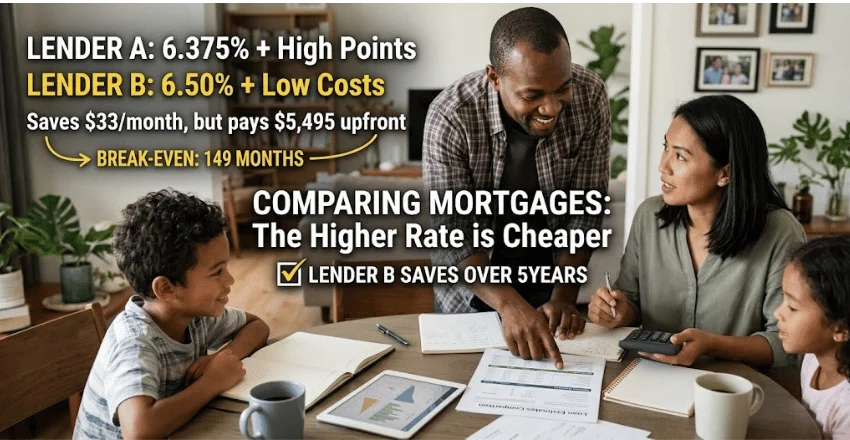
Take a $400,000 loan on a 30-year fixed. Lender A quotes the lower rate but charges for it. The second quotes higher and asks for almost nothing upfront.
| Lender A | Lender B | |
| Rate | 6.375% | 6.50% |
| Monthly principal and interest | $2,495 | $2,528 |
| Upfront lender charges | $5,495 (1 point plus $1,495 origination) | $600 |
| Cost over five years | $155,224 | $152,296 |
Lender A saves $33 a month. Against $4,895 more in upfront charges, that takes roughly 149 months, over 12 years, to break even. The median American homeowner refinances or moves well before then, which is why the higher rate is the cheaper loan here.
Cheaper is not always lower.
Run the same math on your own two strongest offers. It takes five minutes, and it is the single most useful thing you can do with a Loan Estimate.
How to run the comparison in one week
- Pull your credit and fix anything obviously wrong before you apply anywhere.
- Pick one lender from each category: a credit union, a non-bank shop, a broker and an online lender.
- Apply to all of them inside the same few days, with identical loan amount, term and points.
- Collect the Loan Estimates, then compare APR first and page 2 charges second.
- Take the strongest offer back to your second choice and ask them to beat it in writing.
- Lock, then keep your finances still until closing. New debt can undo an approval.
Step 6 matters more than people expect. Your file gets re-verified late in the process, and a new car loan can send it backwards. Read what conditional approval involves before you sign anything else.
Our verdict: which type wins

There is no single best lender, but there are clear best-for answers. We recommend a credit union as the first call for most fee-sensitive buyers, because low origination charges do more for a five-year cost than an eighth-of-a-point rate difference does.
One call is never a comparison.
Self-employed? Start with a broker. Using a VA entitlement or an FHA file? A specialist non-bank lender will usually be quicker and more comfortable with it. Salaried, strong credit, simple purchase? An online lender is likely your cheapest quote. Sitting on a seven-figure balance at your bank? Ask them what they will do for you first, then shop it anyway.
Your next step
Set aside one morning. Request quotes from four different types of lenders, put the Loan Estimates side by side, and compare APR before anything else. On a $400,000 loan, that morning is routinely worth several thousand dollars.
This article is general information about how the US mortgage market works, not personalized financial advice. Rates move weekly, so check the current survey figure and your own written offers before you commit.
If you want to know about Enzyme Cleaner then visit our Home For Sale category.
Frequently asked questions
No, though the spread is narrower than most people assume. Base pricing comes from the same secondary market, so the visible difference is mostly margin and fees. That is exactly why the APR line is worth more attention than the rate.
Far less than shopping only one lender costs you. According to the CFPB, multiple mortgage credit checks made inside 45 days are recorded on your credit report as a single inquiry. Keep every application inside that window.
Sometimes. Wholesale pricing can undercut retail, and the broker’s compensation appears on your Loan Estimate. Judge it on the APR that comes back, not on the label.
Yes, and it very often is. Your rate, term, and balance cannot change when servicing transfers. You simply get a notice telling you where to send the payment.
An unlocked quote is a snapshot and can move the same afternoon. A lock typically runs 30 to 60 days, and extensions cost money.