If your home has asbestos siding, you do not automatically need to remove it. Intact material can often remain safely in place if no one disturbs it. Problems arise when old panels crack, crumble, or get cut during renovation. A professional inspection can help you choose the safest next step.
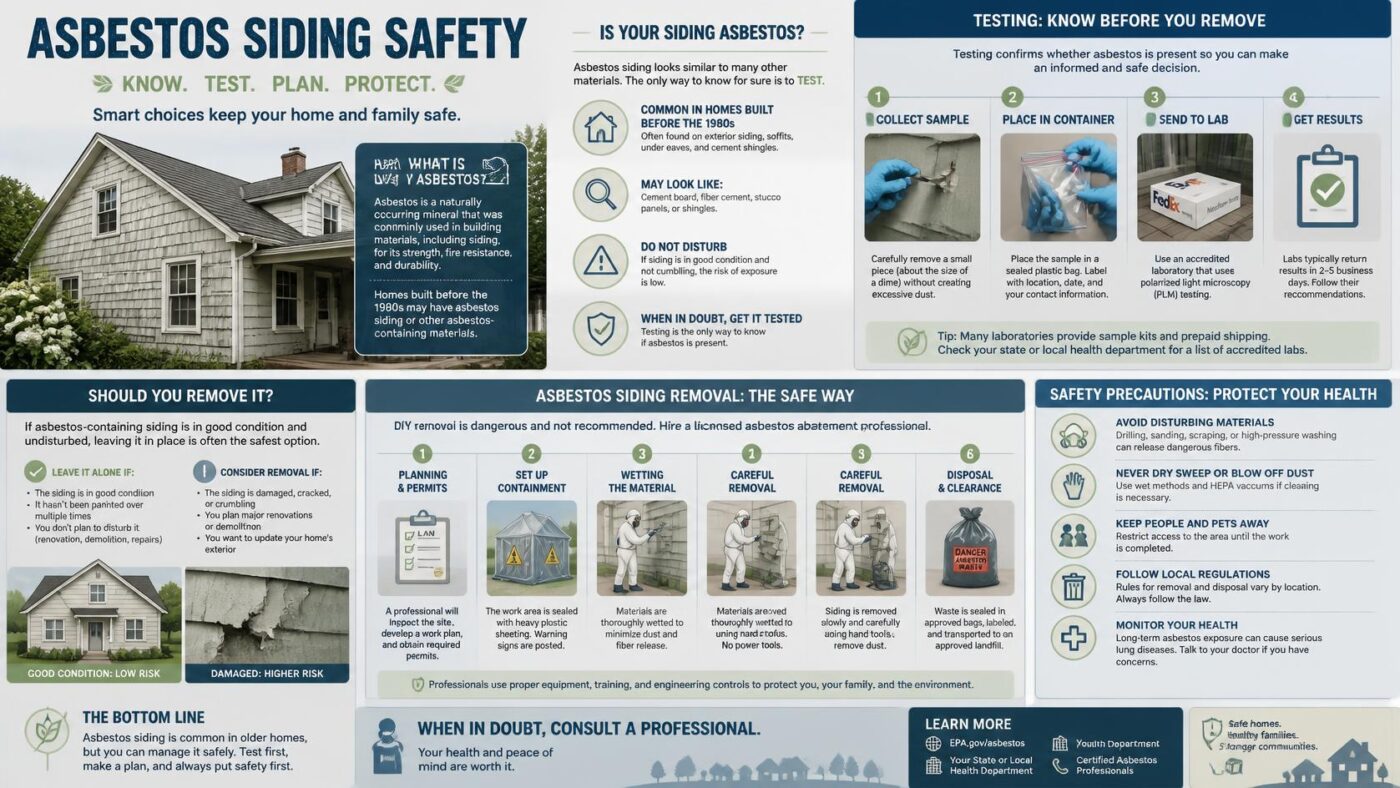
Quick answer: Many older American homes have asbestos-cement siding. Intact panels often present lower exposure risk because cement binds the fibers. The main danger comes from cutting, sanding, drilling, or breaking suspected material. Professional laboratory testing is the only reliable way to confirm asbestos.
Key Facts at a Glance
| Question | Practical answer |
| Can appearance confirm asbestos? | No. Laboratory testing is needed for confirmation. |
| Is intact material always an emergency? | No. Undamaged material may often remain undisturbed. |
| What creates the main risk? | Cutting, sanding, drilling, breaking, or other disturbance. |
| Should homeowners take their own sample? | EPA recommends using a trained asbestos professional. |
| Can old cladding sometimes be covered? | Yes, professional enclosure may be possible in suitable conditions. |
| When is removal considered? | Major damage, remodeling, or work that will disturb the material. |
| Typical 2026 professional removal cost | About $708–$5,696 nationally, based on HomeAdvisor data. |
| Do rules differ by location? | Yes. State and local requirements can be stricter than federal rules. |
Key Takeaways
- Never rely on appearance alone to confirm asbestos.
- Avoid sanding, drilling, sawing, scraping, or breaking suspect panels.
- Undamaged material can often remain safely undisturbed.
- Testing makes sense before renovation or other work that could disturb the exterior.
- Professional repair, enclosure, or removal may be appropriate depending on condition.
- Check state and local requirements before planning removal or disposal.
What Is Asbestos-Cement Siding?
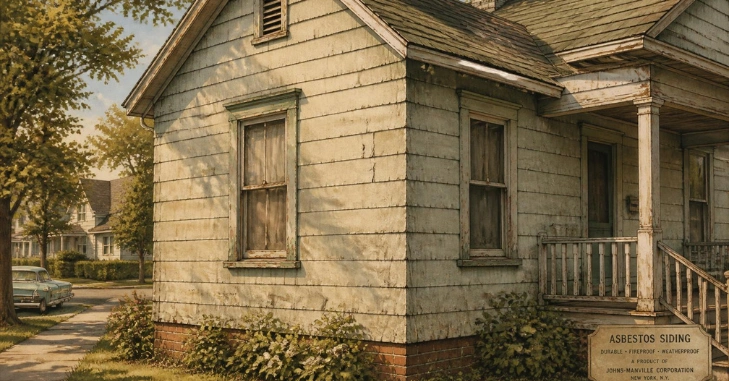
This exterior material combines cement with asbestos fibers that add strength and heat resistance. It was widely used on older American buildings during the twentieth century. Products often appeared as rigid shingles or flat cement-like panels. Many examples remain on houses today.
The presence of older cement shingles does not prove they contain asbestos. Modern fiber-cement siding can resemble some older materials. Age, texture, and dimension provide clues only. The EPA recommends laboratory testing when confirmation is necessary.
How to Identify Asbestos Siding Without Guessing
Suspect Asbestos Siding panels may look rigid, brittle, chalky, or cement-like. Some paint layers show textures, scalloped patterns, or overlapping rectangular shapes. Older layers of paint can hide many original surface details. None of these features proves what the material contains.
Several clues may justify extra caution:
- The home or cladding dates from the mid-twentieth century.
- Panels are rigid rather than flexible.
- They have a cement-like appearance.
- Edges look brittle or chipped.
- Multiple old paint layers cover the surface.
- Similar material appears on a detached garage or addition.
Do not break a corner to inspect the inside. Do not drill a hole to examine the dust. The EPA advises homeowners against collecting samples themselves because poor sampling can release fibers. A trained professional can take a controlled sample and send it to a qualified laboratory.
If testing shows aluminum instead, maintenance becomes a different project. Homlyst’s guide to painting aluminum siding explains preparation and coating considerations for confirmed metal panels. Do not use those preparation methods on suspected asbestos-containing material.
Is the Material Dangerous While It Is on the House?
Asbestos becomes a health concern mainly when microscopic fibers enter the air and are inhaled. According to ATSDR, exposure can contribute to mesothelioma, lung cancer, asbestosis, and pleural disease. Disease risk depends on exposure amount, frequency, duration, and other personal factors. Prevention focuses on limiting additional airborne exposure.
Cement-bound exterior products are less easily crumbled than many softer asbestos materials. That does not make careless work safe. Drilling, grinding, sanding, sawing, or breaking panels can release fibers from the cement matrix. The EPA advises leaving undamaged asbestos-containing materials alone.
Weather damage deserves attention because exterior cladding can be exposed to damage. Look for broken corners, loose pieces, major cracks, or areas affected by impact. Do not scrape damaged sections or sweep suspicious debris. A qualified asbestos professional can evaluate whether repair or removal makes more sense.
Should You Leave It, Cover It, or Remove It?
The correct approach depends on condition, renovation pitfalls, and your long-term goals. Removal is not automatically safer because removal itself disturbs the material. EPA guidance recognizes repair and enclosure as possible professional management approaches. The table below summarizes the main choices.
| Option | Often considered when | Main advantage | Main concern |
| Leave undisturbed | Panels are sound and no renovation is planned | Avoids unnecessary disturbance | Requires ongoing monitoring |
| Professional repair or sealing | Damage is limited and manageable | Can stabilize existing material | Material remains on the property |
| Professional enclosure | Existing panels are stable enough to remain | Avoids full demolition | Fastening and moisture details need careful planning |
| Professional removal | Damage is extensive or renovation requires disturbance | Clears the old cladding | Greater cost, regulation, and disposal needs |
Leaving Sound Material in Place
Leaving intact material alone can be a reasonable option. EPA guidance states that undamaged asbestos-containing materials usually do not need removal. Homeowners should monitor the exterior for new cracks or impact damage. Future contractors should know about the material before starting work.
Routine maintenance around the house can also protect exterior assemblies from water. Homlyst’s signage may contribute to moisture problems around walls, trim, and foundations. Homlyst’s guide to comparing gutter companies can help when drainage equipment needs replacement. Fix water sources before cosmetic exterior work.
Repairing or EnclThese treatments leave theThese treatments leave theng It
Repair can be a limitedd release. The original material remains in place after these treatments. The contractor should avoid unnecessary damage during fastening or preparation. Local requirements may affect which methods are permitted.
EncloFirst, evaluate the existing panels. First, evaluate the existing panels for a new exterior finish without full abatement. First, evaluate the existing panels for Homlyst suitability and moisture concerns. If you are comparing modern replacements, review Homlyst’s fiber cement siding cost guide. That can help separate new-cladding costs from asbestos management costs.
Removing and Replacing It
Removal may become appropriate when large areas are badly damaged. It may also be necessary when remodeling will disturb the old exterior. Professional abatement reduces the chance of breakage and improper disposal. Contractors should follow the requirements that apply in your state and municipality.
Removal also provides access to the wall beneath the old cladding. Address crumbling masonry, sheathing, flashing, trim, and nearby masonry before signs of new exterior finish show the problem. Homlyst’s repointing brick guide covers common mortar deterioration signs.
What Does Testing and Removal Cost in 2026?
Costs vary. Each house has different size, height, access, and disposal needs. HomeAdvisor’s June 2026 data puts professional siding removal at about $708 to $5,696, with an average near $3,202. It also cites an approximate figure of $8 per square foot. Local bids may fall outside those figures.
Testing, permits, disposal, wall repairs, and replacement cladding may create additional costs. A quote should separate abatement from new siding installation whenever possible. Ask what testing, containment, disposal, cleanup, and documentation the quoted amoDon’t judge aDon’t judge ant includes. Comps make contractor estimates easier to evaluate.
A low removal bid should not be judged on price alone. Ask whether your state requires the contractor’s licenses or certifications. Confirm where waste will be taken and which party handles required notices. A written scope can prevent costly misunden’tndings the same way.
U.S. Rules Can Vary by State and City
Federal asbestos requirements do not apply identically to every residential renovation. EPA guidance specifically tells homeowners to check state and local regulations for residential siding work. Some jurisdictions impose licensing, handling, or disposal requirements beyond federal rules. Never assume a neighbor’s project followed the rules that apply to your property.
The EPA maintains a current list of state asbestos contacts. Your state environmental or health agency can explain local requirements. Your city or county building department may also regulate permits and demolition activities. Check these requirements before signing an abatement contract.
Disposal rules deserve the same attention as removal rules. Old panels should not simply enter ordinary construction debris unless local regulations allow that disposal method. Qualhelptors should explain their waste process in writing—document confirmation or future property records.
Planning a Safer Exterior Upgrade
Start with confirmation before designing the renovation around an assumption. A professional can inspect the cladding and determine whether laboratory sampling is appropriate. Once you know the material, contractors can price realistic management options. That sequence avoids paying for one option only to find it doesn’t work.
Next, examine the entire exterior system rather than focusing on the panels alone. Water damage, failing trim, deteriorated mortar, or poor drainage may change the project scope. Address those underlying problems before installing a new finish. New cladding cannot correct structural or moisture defects hidden beneath it.
Request separate prices for testing, abatement, repairs, and replacement. This makes alternatives easier to compare. It also shows which costs disappear if the existing material can remain safely enclosed. Keep inspection reports and disposal records with your home documents.
What to Do Next
If you suspect older exterior panels contain asbestos, avoid disturbing them. Photograph visible damage from a safe distance and gather renovation records if available. Then contact a qualified asbestos inspector and check your state requirements. That gives you reliable information before spending money on repair, enclosure, or removal.
Frequently Asked Questions
Is Asbestos Siding Safe If It Is in Good Condition?
Intact cement-bound material generally presents less exposure risk than damaged or disturbed material. EPA guidance says sound asbestos-containing materials should often be left alone. The key is preventing activities that release fibers. Have a professional evaluate it before remodeling, drilling, or replacing nearby components.
Can You Paint Old Asbestos-Cement Panels?
Painting may sometimes be part of a professional sealing or maintenance strategy. Surface preparation must not create asbestos dust through sanding, aggressive scraping, or similar disturbance. Product compatibility and existing condition also matter. Get professional advice before proceeding.
Can I Install New Cladding Over the Old Panels?
Professional enclosure may be possible when existing panels are stable. The installation must avoid unnecessary breakage and manage water correctly. Local regulations and fastening requirements can affect the project. Ask the installer to explain the proposed method before approving work.
Can Homeowners Remove It Themselves?
Rules vary significantly across the United States. Some residential projects may fall outside particular federal requirements, while state or local restrictions still apply. DIY removal also increases the chance of breakage, exposure, and disposal mistakes. Check local regulations and strongly consider a qualified asbestos contractor.
Do You Need Testing Before Selling a House?
Testing requirements depend on the property, transaction, state law, and known conditions. A visual inspection alone cannot confirm asbestos content. Sellers must follow applicable disclosure requirements and avoid unsupported claims. A local real-estate professional or attorney can explain transaction-specific obligations.