
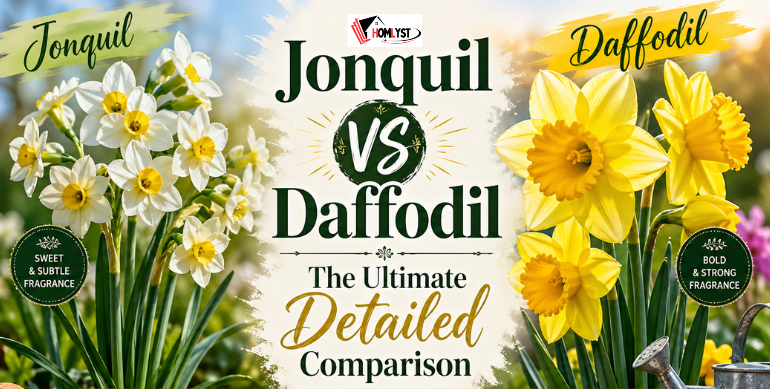
Understanding the difference between jonquil vs daffodil is not just about botanical classification; it is also about improving garden planning, seasonal landscaping, and flower selection based on fragrance, height, blooming time, and visual impact.
Spring is a season of renewal, color, and life, and few flowers represent this transformation better than jonquils and daffodils. These vibrant yellow blooms are among the earliest signs that winter has ended, bringing warmth and brightness back to gardens, parks, and natural landscapes.
Because of their similar appearance, many people often confuse jonquils with daffodils, assuming they are the same flower. While they are closely related and belong to the same plant family, the genus Narcissus, they are not identical in structure, fragrance, growth habits, or gardening purposes.
Daffodils are widely recognized for their bold, striking appearance, often dominating spring landscapes with their bright, trumpet-shaped flowers. Jonquils, on the other hand, are known for their softer look, clustered blooms, and strong, sweet fragrance that adds a sensory dimension to gardens.
For gardeners, landscapers, and flower lovers, knowing how these two plants differ can completely change how a garden is designed and experienced. Whether the goal is to create a visually dramatic spring display or a fragrant, intimate garden space, choosing between jonquils and daffodils is important.
This guide explores every essential detail, including botanical background, plant height, appearance, fragrance strength, blooming season, planting techniques, and expert gardening insights to help you make informed decisions.
Jonquil vs Daffodil Comparison Table
| Feature | Jonquil vs Daffodil Comparison |
|---|---|
| Plant Family | Both belong to the Narcissus genus |
| General Name | Daffodil is the broad term; jonquil is a subtype |
| Scientific Name | Daffodil includes many species; jonquil is Narcissus jonquilla |
| Plant Type | Perennial flowering bulb plant |
| Height Range | Daffodil: 15–55 cm, Jonquil: 25–40 cm |
| Stem Structure | Daffodil has sturdy single stems, and jonquil has clustered stems |
| Flower Count | Daffodil usually produces one flower per stem, while jonquil produces multiple flowers |
| Flower Size | Daffodil flowers are larger, jonquil flowers are smaller and delicate |
| Flower Shape | Daffodil has a trumpet-shaped bloom, and jonquil has smaller cup-like flowers |
| Leaf Type | Daffodil leaves are broad and flat, jonquil leaves are thin and round |
| Color Range | Daffodils come in yellow, white, orange, and bicolor shades |
| Jonquil Color | Mostly yellow or golden shades |
| Fragrance | Daffodils have mild or no fragrance |
| Jonquil Fragrance | Jonquils have a strong, sweet fragrance |
| Bloom Time | Daffodils bloom in early spring |
| Jonquil Bloom Time | Jonquils bloom in mid-spring |
| Climate Preference | Daffodils tolerate colder climates well |
| Jonquil Climate | Jonquils prefer slightly warmer conditions |
| Sunlight Requirement | Both grow best in full sun or partial shade |
| Soil Type | Require well-drained, fertile soil |
| Water Needs | Moderate watering is required, avoid waterlogging |
| Maintenance | Both are low-maintenance and easy to grow |
| Garden Use | Daffodils are ideal for landscapes and large gardens |
| Jonquil Use | Jonquils are perfect for fragrance gardens and containers |
| Symbolism | Daffodils represent rebirth, jonquils symbolize affection and warmth |
Botanical Background: Jonquil vs Daffodil
Both jonquils and daffodils belong to the Narcissus genus, which includes more than 50 species and thousands of hybrid varieties. These flowers are native to Europe, North Africa, and parts of Asia.
Daffodils (General Group)
“Daffodil” is a broad umbrella term used for all Narcissus flowers. This includes large trumpet daffodils, double daffodils, and miniature varieties.
They are known for:
- Bright yellow or white blooms
- A central trumpet-shaped corona
- Strong presence in spring landscapes
Jonquils (Specific Subgroup)
Jonquils are a specific species within the daffodil family, scientifically known as Narcissus jonquilla.
They are recognized by:
- Narrow, round, reed-like leaves
- Small clustered flowers per stem
- Strong, sweet fragrance
Important fact: All jonquils are daffodils, but not all daffodils are jonquils.
Plant Height Comparison (Important Gardening Factor)

One of the most useful differences for gardeners is plant height.
Daffodil Height
Daffodils vary widely in size depending on the variety:
- Miniature types: 6–10 inches (15–25 cm)
- Standard types: 12–20 inches (30–50 cm)
- Large hybrid varieties: up to 22 inches (55 cm)
Their taller structure makes them ideal for:
- Garden borders
- Landscape mass planting
- Park decoration
Jonquil Height
Jonquils are generally more compact:
- Average height: 10–16 inches (25–40 cm)
Their shorter and delicate structure makes them perfect for:
- Small home gardens
- Pots and containers
- Fragrance-focused flower beds
Appearance Differences: Shape, Color, and Structure

Daffodils Appearance
Daffodils are visually bold and structured:
- One large flower per stem (usually)
- Prominent trumpet (central cup)
- Broad, flat green leaves
- Strong visual impact in landscapes
Common colors
- Bright yellow
- White
- Orange center combinations
- Bi-color hybrids
Jonquils Appearance
Jonquils look softer and more delicate:
- Multiple small flowers per stem
- Rounded floral cup instead of a long trumpet
- Thin, grass-like leaves
- Clustered blooming style
Common colors
- Light yellow
- Golden yellow
- Occasionally creamy tones
Fragrance Comparison (Major Difference)

Fragrance is one of the biggest reasons gardeners prefer jonquils.
Jonquil Fragrance
- Strong, sweet, and noticeable scent
- Can fill an entire garden area
- Often used in perfumes and fragrance breeding.
Daffodil Fragrance
- Mild or sometimes almost odorless
- Some modern hybrids have no fragrance.
- The focus is more on visual appeal than on scent.
If smell matters, jonquils win easily.
Blooming Season and Climate Behavior

Both flowers bloom in spring, but timing depends on climate and variety.
Daffodil Blooming Season
- Early spring bloomers
- In warmer regions: late winter to early spring
- In colder regions: March–April
Some hybrid daffodils can bloom very early, even pushing through late snow.
Jonquil Blooming Season
- Mid-spring bloomers
- Prefer slightly warmer conditions.
- Bloom slightly later than most daffodils
This difference helps gardeners naturally extend the flowering season.
Planting Guide (Step-by-Step Expert Instructions)

Both jonquils and daffodils grow from bulbs and require similar planting methods.
Best Time to Plant
- Autumn (September to November)
- Before the ground freezes
Soil Requirements
- Well-drained soil is essential.
- Slightly acidic to neutral pH (6.0–7.0)
- Loamy soil enriched with compost
Sunlight Needs
- Full sun (6+ hours daily)
- Partial shade is also acceptable.
Planting Depth
- 2–3 times the height of the bulb
- Usually 4–6 inches deep
Spacing
- 3–6 inches apart
- Allows proper root expansion
Watering and Maintenance

Watering Needs
- Light watering after planting
- Moderate moisture during growth
- Avoid water stagnation completely.
Bulbs are sensitive to overwatering, which can cause rot.
After Bloom Care
- Do not cut leaves immediately.
- Leaves must yellow naturally.
- This helps the bulb store energy for next season.
Fertilization Tips
- Use low-nitrogen fertilizer
- Apply after the flowering season.
- Compost improves long-term soil health.
Landscaping and Garden Design Uses

Daffodils in Landscaping
- Large-scale public gardens
- Roadside planting
- Bright spring borders
- Naturalized meadow-style gardens
Their tall and bold flowers create a visual impact from a distance.
Jonquils in Landscaping
- Fragrance gardens
- Small home flower beds
- Decorative pots and balconies
- Mixed flower arrangements
Jonquils are ideal for close-up sensory enjoyment.
Symbolism and Cultural Meaning
Daffodils Meaning
- Renewal and rebirth
- Hope after winter
- New beginnings
They are often associated with spring festivals and celebrations.
Jonquils Meaning
- Desire and affection
- Emotional warmth
- Romantic symbolism
In some cultures, jonquils are given as gifts to express a deep emotional connection.
Common Gardening Problems

Even though both flowers are easy to grow, some issues may occur:
1. Poor Blooming
- Cause: insufficient sunlight
- Solution: relocate to a sunny area
2. Bulb Rot
- Cause: overwatering or poor drainage
- Solution: improve soil drainage
3. Weak Flowers
- Cause: overcrowded bulbs
- Solution: divide bulbs every 3–4 years
Expert Gardening Insight

From a horticultural standpoint, both jonquils and daffodils are perennial bulbs, meaning they return every year without replanting. They are extremely reliable and widely used in temperate gardening zones.
Experts recommend combining both types for a staggered bloom effect, where:
- Daffodils bloom first (early spring color burst)
- Jonquils bloom later (extended fragrance phase)
This combination enhances:
- Garden biodiversity
- Seasonal flower continuity
- Visual and sensory balance
Jonquil vs Daffodil Summary Table
| Feature | Daffodil | Jonquil |
| Height | 15–55 cm | 25–40 cm |
| Flowers per stem | Usually, 1 | Multiple |
| Fragrance | Mild | Strong |
| Leaf type | Broad | Thin, reed-like |
| Bloom time | Early spring | Mid-spring |
| Visual impact | Bold | Delicate |
| Best use | Landscaping | Fragrance gardens |
Conclusion
The comparison between jonquil vs daffodil highlights that both flowers are unique and serve different purposes in gardening and landscape design. Daffodils stand out as bold, tall, and visually dominant flowers that create powerful spring displays in large gardens and open spaces. Their structured form and bright colors make them one of the most recognizable symbols of spring renewal.
Ultimately, choosing between jonquils and daffodils is not about preference alone but about purpose. Whether you want a dramatic visual impact or a fragrant and gentle atmosphere, both flowers offer exceptional value. For gardeners seeking the best results, planting both together is the most effective way to enjoy a rich, layered, and visually stunning spring garden.
Want to know about House Extension: A Practical Guide to Expanding Your Home the Smart Way Check out our Luxury Properties category.
Frequently Asked Questions (FAQs)
No. Jonquils are a type of daffodil, but not all daffodils are jonquils.
Jonquils are significantly more fragrant than daffodils.
Daffodils grow up to 55 cm, while jonquils usually grow up to 40 cm.
The best time is autumn before winter frost.
Jonquils are better for fragrance, while daffodils are better for visual impact.

