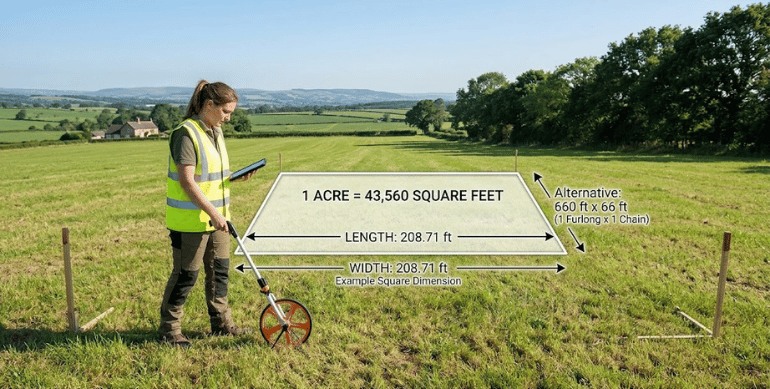
Searching 1 acre to feet length and width usually means you want actual side measurements. A square parcel measures about 208.71 feet long by 208.71 feet wide. However, the same land area can have many other dimensions because acreage measures area, not shape.
Direct answer: One acre contains exactly 43,560 square feet. If the parcel is a perfect square, each side measures about 208.71 feet. It can also measure 66 feet by 660 feet, 100 feet by 435.6 feet, or any other length and width whose product equals 43,560.
Quick Facts About the Size
| Measurement | Value |
|---|---|
| Total area | 43,560 square feet |
| Square dimensions | About 208.71 ft × 208.71 ft |
| Traditional rectangle | 66 ft × 660 ft |
| 100-foot-wide parcel | 100 ft × 435.6 ft |
| 200-foot-wide parcel | 200 ft × 217.8 ft |
| Square perimeter | About 834.84 linear feet |
| Square yards | 4,840 |
| Square miles | 1/640 |
The U.S. Bureau of Land Management uses 43,560 square feet as the standard land area. It also recognizes several rectangular dimension combinations that produce that total. This makes the area consistent even when parcel shapes differ.
1 Acre to Feet Length and Width: Why There Is No Single Answer
An acre measures area, not distance. So it has no required length or width on its own. The two dimensions only need to multiply to 43,560 square feet.
For example, a long, narrow parcel can cover the same area as a square parcel. A 66-foot width paired with 660 feet of length produces 43,560 square feet. A 100-foot width requires 435.6 feet of depth instead.
This distinction matters when comparing real estate listings. Two properties with identical acreage may feel completely different when you walk them. Their frontage, depth, building options, and fencing requirements can also differ considerably.
What Are the Dimensions of a Square Parcel?
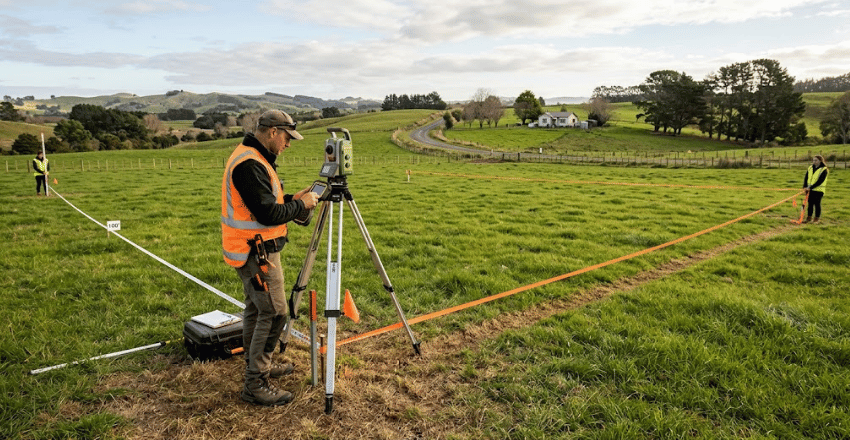
A perfect square is the easiest way to visualize this amount of land. To find its side length, take the square root of 43,560. The result is approximately 208.71 feet.
That means a square lot is about 208.71 feet from front to back. It is also approximately 208.71 feet from side to side. Multiplying those rounded measurements gives almost exactly 43,560 square feet.
This shape is useful for visualization, but real properties are rarely perfect squares. Roads, subdivision layouts, terrain, and neighboring boundaries often create different shapes. Your deed or survey should provide the actual dimensions of a specific property.
Common Length and Width Combinations
Several rectangular dimensions can produce the same 43,560-square-foot area. These examples help show why acreage alone does not describe a parcel’s shape. They are also useful when comparing frontage and lot depth.
| Width | Length | Total Area |
|---|---|---|
| 50 ft | 871.2 ft | 43,560 sq ft |
| 66 ft | 660 ft | 43,560 sq ft |
| 100 ft | 435.6 ft | 43,560 sq ft |
| 132 ft | 330 ft | 43,560 sq ft |
| 165 ft | 264 ft | 43,560 sq ft |
| 198 ft | 220 ft | 43,560 sq ft |
| 208.71 ft | 208.71 ft | About 43,560 sq ft |
The 66-by-660-foot configuration has strong historical ties to land surveying. Sixty-six feet equals one surveyor’s chain, while 660 feet equals ten chains. Multiplying those dimensions gives the standard area used today.
For more background on the conversion itself, Homlyst’s square-foot conversion guide explains how 43,560 square feet relates to other measurements. The site’s one-acre land overview also covers practical land uses. These resources can support readers who need broader property information.
How to Calculate the Missing Length or Width
You can calculate a missing dimension whenever you know the other side. Start with the total area of 43,560 square feet. Divide that number by the dimension you already know.
Use this simple formula:
Missing side in feet = 43,560 ÷ known side in feet
Suppose a property has 120 feet of road frontage. Divide 43,560 by 120 to find the required depth. The answer is 363 feet.
A 120-foot-wide rectangle would therefore need to be 363 feet deep. Multiplying 120 by 363 returns 43,560 square feet. This calculation works for any rectangular parcel.
Example With 150 Feet of Frontage
Start with the known frontage of 150 feet. Divide 43,560 by 150 to get 290.4 feet. The required depth would be 290.4 feet.
Now multiply 150 by 290.4 as a check. The result is exactly 43,560 square feet. This simple verification helps prevent measurement mistakes.
How Many Feet Around the Property?
Perimeter measures the distance around a parcel, not the area inside it. Because different shapes have different boundaries, this land size has no single perimeter. You need the actual side measurements first.
A square measuring about 208.71 feet per side has a perimeter near 834.84 feet. You find that number by multiplying 208.71 by four. That estimate can help with early fencing or boundary planning.
A 66-by-660-foot rectangle has a much larger perimeter. Its boundary totals 1,452 linear feet because the shape is longer and narrower. Therefore, equal land areas can require very different amounts of fencing.
This difference can affect project costs. A long parcel may require hundreds of additional feet of fencing compared with a square layout. Always calculate from the surveyed boundary before ordering materials.
Why Parcel Shape Matters When Buying Land
Square footage tells you how much land exists, but shape affects how you can use it. A wide parcel may provide more road frontage and flexible building placement. A narrow parcel may offer more depth but fewer choices near the entrance.
Setback rules can make these differences more important. Local zoning may require buildings to stay a certain distance from property lines. A narrow property could lose more usable building width after those setbacks.
Access also deserves attention when buying a property. An irregular boundary, easement, creek, or steep section can reduce practical usable space. The recorded acreage alone does not reveal those limitations.
For broader property research, Homlyst’s Urban Real Estate section provides related home and land information. Buyers should still check local zoning records for the specific parcel. A professional boundary survey remains the better source for legal dimensions.
How to Confirm the Size of a Real Property
Start with the deed, recorded plat, or assessor information for an initial reference. These documents may show acreage, dimensions, or both. County records can also help identify the recorded parcel boundaries.
Next, compare those records with visible property features. Fences and landscaping do not always follow the legal boundary. Never assume an existing fence marks the surveyed property line.
Use online maps only for rough planning. Satellite measurement tools can provide useful estimates, but they do not replace legal boundary work. Image alignment and mapping data can introduce small errors.
Hire a licensed land surveyor when exact boundaries matter. This is especially important before construction, fencing, subdivision, or a boundary dispute. Survey results can identify corners and dimensions that online measurements cannot legally establish.
Converting Other Lot Sizes Into Acres
You can also work backward from square feet. Multiply the property’s length by its width to find its square footage. Then divide the result by 43,560.
For example, a 100-by-200-foot lot contains 20,000 square feet. Dividing 20,000 by 43,560 gives approximately 0.459. That property therefore covers about 0.46 of the standard land unit.
A 200-by-300-foot property contains 60,000 square feet. Dividing 60,000 by 43,560 gives approximately 1.38. This method makes rectangular lot comparisons straightforward.
Frequently Asked Questions
What is 1 acre to feet length and width?
A square version measures approximately 208.71 feet by 208.71 feet. The total area is always 43,560 square feet. Other length-and-width combinations are equally valid as long as their product reaches that total.
Is 208 feet by 208 feet exactly the right size?
No, 208 by 208 feet equals only 43,264 square feet. That figure falls 296 square feet short. A more accurate side length is about 208.71 feet.
How many square feet are in this land measurement?
The standard area is exactly 43,560 square feet. This value is used for U.S. land measurement and surveying references. Changing the parcel’s shape does not change that total area.
Can the property be long and narrow?
Yes, the shape can be long, narrow, square, or irregular. A 50-by-871.2-foot rectangle still contains 43,560 square feet. Shape changes dimensions and perimeter, but not area.
If my lot is 100 feet wide, how deep should it be?
A 100-foot-wide rectangular lot needs 435.6 feet of depth. Multiply 100 by 435.6 to get 43,560 square feet. This is one useful example for comparing narrow residential or rural parcels.
How many linear feet of fencing would a square property need?
A perfect square needs about 834.84 linear feet around its outer boundary. That estimate assumes four sides of approximately 208.71 feet. Gates, terrain, and surveyed boundary details may change a real fencing project.
The Bottom Line
The simplest answer starts with 43,560 square feet. A square parcel is about 208.71 feet by 208.71 feet, but those dimensions aren’t required. Any shape covering the same area can represent the same land measurement.
Use length multiplied by width when checking a rectangular property. For a purchase or construction project, verify the dimensions in official records. Get a professional survey whenever exact legal boundaries affect your plans.